Photo by Angelos Papadimitriou (Aggelos(Xanthi)) · Wikimedia Commons · CC BY-SA 3.0
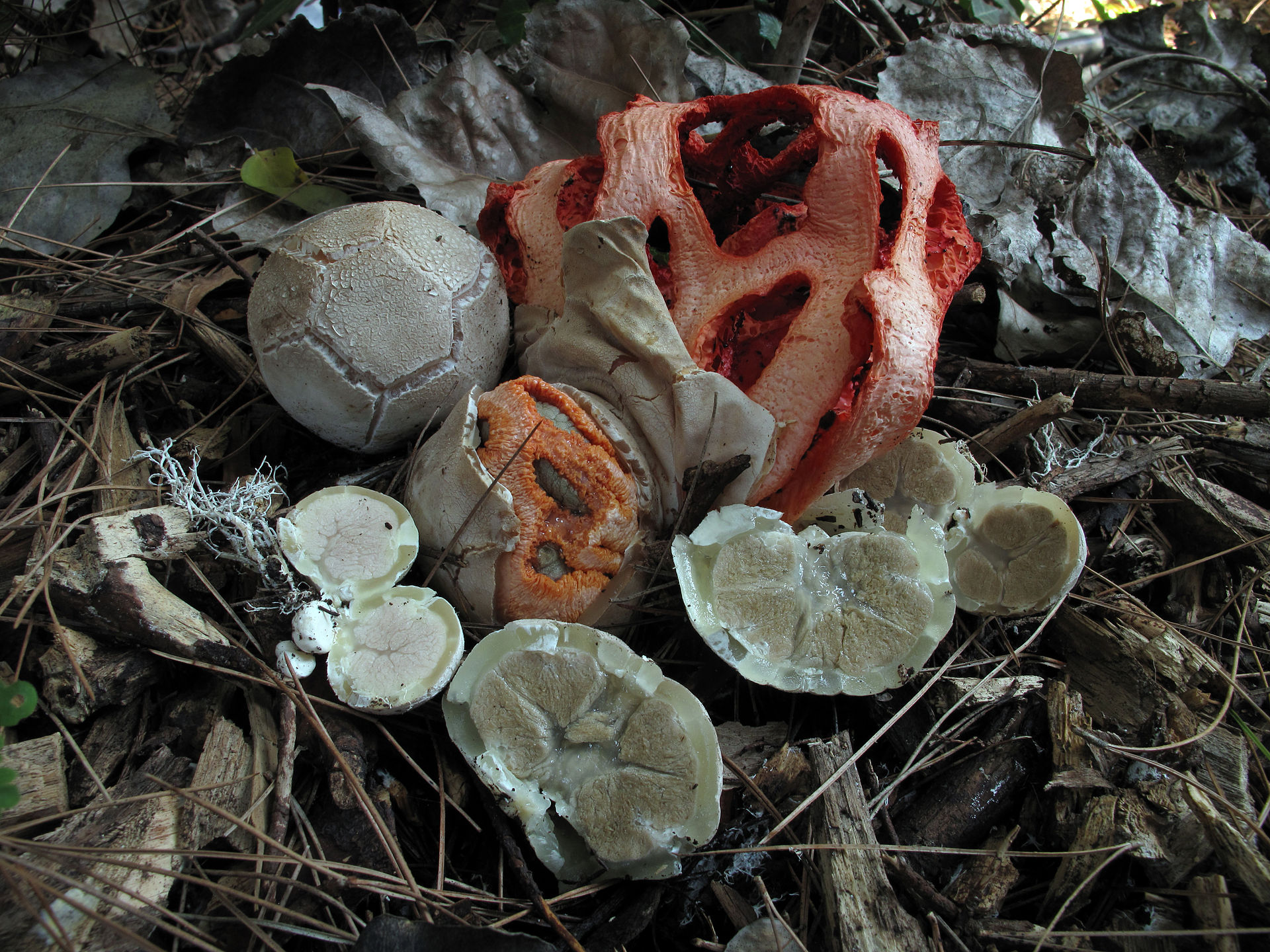
One of the most alien-looking organisms in the fungal kingdom. The red cage stinkhorn erupts from a white egg to form an intricate lattice sphere that looks like something from another planet, then attracts flies with its putrid rotting-meat stench.
If you designed a mushroom to maximize the number of people who would stop, stare, and say 'what on earth is that,' you would end up with Clathrus ruber. It starts life as a smooth, whitish egg nestled in leaf litter or mulch, looking like an oversized puffball. Then, over the course of just a few hours, the egg splits open and a vivid red lattice structure expands outward like a cage or wiffle ball, reaching 5 to 15 cm across. The interior surfaces of the lattice arms are coated with a dark, olive-brown spore mass called gleba, which smells exactly like rotting meat.
The stench is the point. Clathrus ruber is a stinkhorn, and like all stinkhorns, it has outsourced its spore dispersal to flies. The gleba's putrid odor attracts blowflies and other carrion insects, which land on the sticky spore mass, get coated in spores, and carry them to new locations. It is a brilliant evolutionary strategy disguised as a foul practical joke.
Originally a Mediterranean species, the red cage has spread to gardens, parks, and mulched landscapes across the warmer parts of Europe, North America, Australia, and beyond. It seems to love wood chip mulch, and landscapers in the American South encounter it regularly. Despite the dramatic appearance, it is harmless to plants and soil. The smell, however, can clear a backyard.
Red Cage Stinkhorn Facts
- ●Clathrus ruber can expand from a closed egg to a full lattice sphere in under six hours, making it one of the fastest-developing macrofungi.
- ●The lattice structure is geometrically precise enough that mathematicians have studied it as a natural example of a truncated icosahedron, the same shape as a soccer ball.
- ●Despite smelling like death, the red cage stinkhorn is completely harmless to garden plants, soil health, and pets. The smell is exclusively a spore-dispersal strategy.
- ●Flies that visit the gleba can carry thousands of Clathrus spores on their bodies, depositing them across a much wider area than wind dispersal alone could achieve.
Stories From the Field
The Backyard Alien in Atlanta
A homeowner in Atlanta posted frantic photos on a gardening forum in 2021 after finding a bright red lattice ball in her mulch bed. She described it as 'an alien egg hatching in my flower garden' and asked if it was dangerous. The responses reassured her it was harmless to her plants, though several people warned about the smell getting worse.
The Italian Stinkhorn Festival
In parts of southern Italy, Clathrus ruber is well known and has local names that translate roughly to 'devil's cage' and 'witch's lantern.' A mycological walking tour in Calabria in 2019 found multiple specimens in an olive grove, much to the delight of photographers and the dismay of anyone standing downwind.
Time-Lapse Goes Viral
A 2020 time-lapse video showing a Clathrus ruber emerging from its egg over six hours accumulated millions of views across social media platforms. The egg splits, the red lattice slowly expands like a breathing organism, and flies begin arriving within minutes of full expansion. Comments ranged from 'beautiful' to 'nightmare fuel.'
The Mulch Mystery
A school in North Carolina called a mycologist after red cage stinkhorns appeared repeatedly in their playground mulch. The mycologist explained that Clathrus ruber spores travel in commercial mulch and wood chips. The school was relieved to learn the fungus was harmless but decided to replace the mulch anyway because of the smell.
Where It's Been Found

Based on reported sightings worldwide
How to Identify Red Cage Stinkhorn
Cap
No traditional cap. The fruiting body is a hollow lattice sphere, 5-15 cm across, made of interconnected arms forming a cage-like or net-like structure. Vivid red to orange-red when fresh, fading to pinkish with age. Inner surfaces coated with dark olive-brown gleba (spore mass).
Gills
None. This is a stinkhorn, not a gilled mushroom. Spores are produced in the dark, slimy gleba coating the inner lattice surfaces.
Stem
No true stem. The lattice structure emerges from a white, egg-like volva at the base. The egg is 3-5 cm across, smooth, and connected to white mycelial cords (rhizomorphs) in the soil.
Spore Print
Not applicable in the traditional sense. Spore mass (gleba) is olive-brown to dark brown.
Odor
Intensely foul. Smells like rotting meat, decomposing flesh, or a dumpster in August. The smell can carry for several meters and is designed to attract carrion flies.
Mushrooms That Look Like Red Cage Stinkhorn
Clathrus archeri (Devil's Fingers)
Instead of a lattice cage, devil's fingers produce 4-8 separate tentacle-like arms that spread outward from a central base. Same putrid smell and dark gleba. Also a stinkhorn, also inedible. Both are unmistakable once seen.
Read more on Wikipedia →Colus hirudinosus (Stinky Squid)
Similar lattice structure but with fewer, thicker arms that are fused at the top, forming a column rather than a sphere. Less vividly colored. Also produces foul-smelling gleba. Found in similar warm-climate habitats.
Read more on Wikipedia →Red Cage Stinkhorn Edibility
Not toxic in the traditional sense, but the overwhelming stench of rotting meat makes eating it unthinkable. The egg stage is reportedly edible in some stinkhorn species, but Clathrus ruber is not considered a food species anywhere. The smell alone would defeat any attempt at consumption.
Always verify with local experts before consuming wild mushrooms.
Found something that looks like this in the wild? Don't guess — identify it from a photo with Orangutany and check it against look-alikes before you touch it.