Photo by This image was created by user Sava Krstic (sava) at Mushroom Observer, a source for mycological images.You can contact · Wikimedia Commons · CC BY-SA 3.0
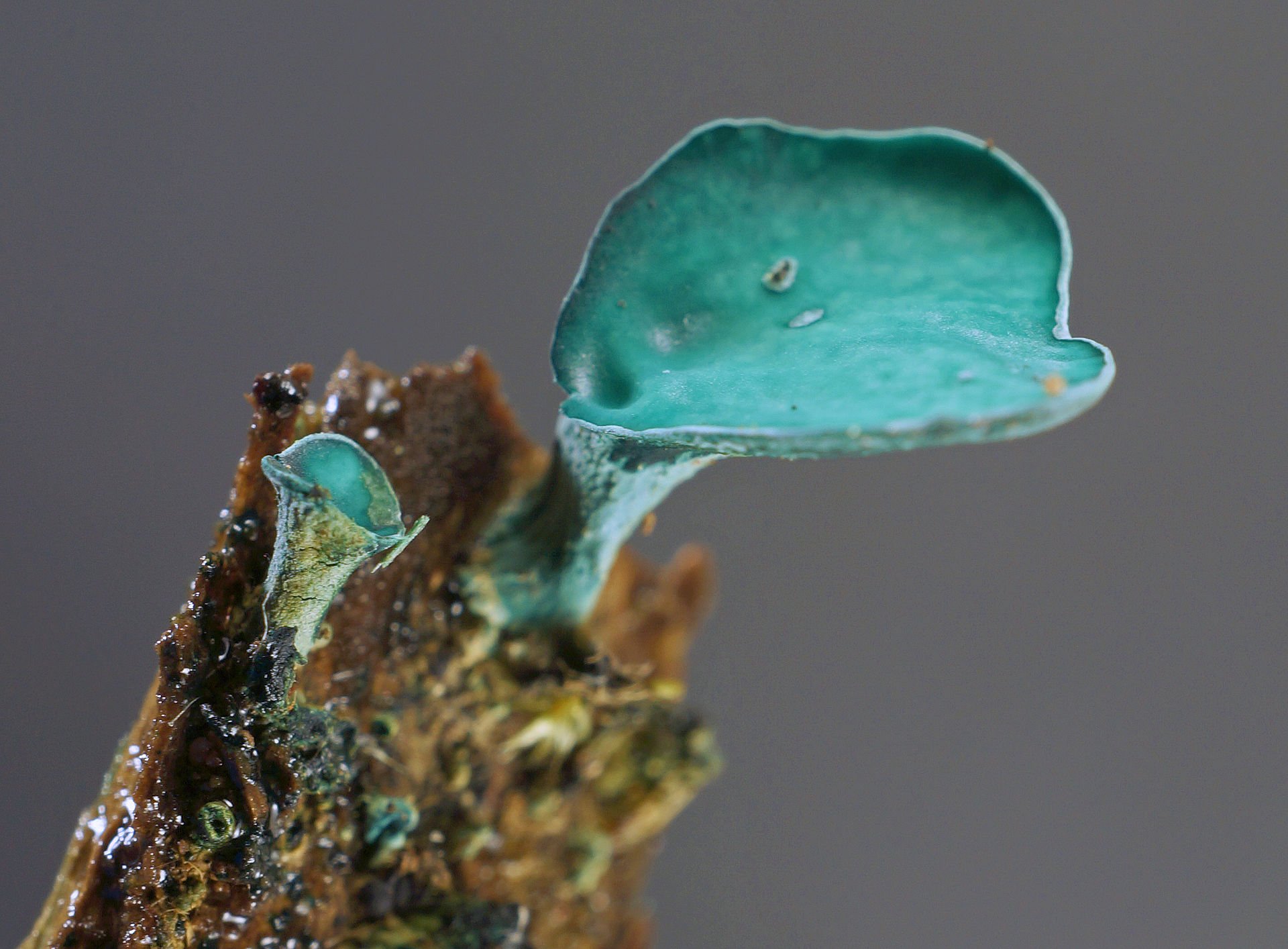
A tiny, stunning turquoise cup fungus whose real artistry happens inside the wood, not on its surface. Chlorociboria aeruginascens stains dead hardwood a vivid blue-green color that has been prized in decorative woodworking since the Italian Renaissance. The fruiting bodies are rare to see; the stained wood is everywhere.
You have almost certainly seen the work of Chlorociboria aeruginascens without knowing it. Walk through any deciduous woodland in the temperate world and flip over a few fallen branches. Sooner or later, you will find one stained a striking blue-green, as if someone painted it with verdigris. That color is produced by xylindein, a pigment secreted by the mycelium of the Green Elfcup as it colonizes dead wood.
The actual fruiting bodies are far less commonly encountered than the stained wood. They are tiny (1-5 mm across), cup-shaped to disc-shaped, and the same intense turquoise as the colonized wood. When they do appear, they emerge in small clusters from the surface of well-rotted branches, and they are genuinely beautiful under a hand lens.
The pigment xylindein is remarkably stable. It does not fade significantly with light exposure, does not wash out with water, and can persist in wood for years or even decades after the fungus has died. This durability caught the attention of Italian Renaissance woodworkers, who used green-stained wood in the decorative inlay technique known as intarsia or Tunbridge ware. Cabinets, boxes, and musical instruments from the 15th and 16th centuries still display patches of vivid green that were originally produced by Chlorociboria.
Modern materials scientists have taken notice too. Xylindein is being studied as a potential sustainable alternative to synthetic dyes and pigments, with applications in textiles, coatings, and even organic electronics. A team at Oregon State University has been leading this research, demonstrating that xylindein can function as an organic semiconductor.
Green Elfcup Facts
- ●The xylindein pigment produced by Chlorociboria is so stable that 500-year-old Italian intarsia woodwork still displays vivid green color from the original fungal staining.
- ●You are far more likely to find Chlorociboria-stained wood than the actual fruiting bodies. Some mycologists estimate the stained wood is encountered 50 to 100 times more frequently than the tiny cups.
- ●Researchers have demonstrated that xylindein can function as an organic semiconductor, opening the door to sustainable, bio-derived electronic components.
- ●The blue-green color of xylindein is produced by a quinone pigment with a unique molecular structure not found in any synthetic dye. Chemists have been trying to replicate it efficiently for industrial use.
Stories From the Field
Renaissance Intarsia and the Green Wood Mystery
Italian woodworkers of the 15th century created elaborate decorative inlays (intarsia) using naturally green-stained wood for foliage and landscape elements. For centuries, the source of the green color was debated. It was not until modern mycological analysis that researchers confirmed the pigment was xylindein, produced by Chlorociboria species colonizing the wood before it was cut and used.
Tunbridge Ware's Secret Ingredient
The distinctive mosaic woodwork known as Tunbridge ware, produced in Kent, England from the 17th to 19th centuries, used Chlorociboria-stained wood for its green elements. Craftsmen would seek out naturally stained branches in local woodlands. Surviving Tunbridge ware boxes in museum collections still show vivid green after 200+ years.
Oregon State's Organic Semiconductor Discovery
Researchers at Oregon State University demonstrated in 2018 that xylindein, the pigment from Chlorociboria, can function as an organic semiconductor. The discovery opened potential applications in sustainable electronics, solar cells, and transistors. A fungal pigment from rotting wood may one day help power electronic devices.
Where It's Been Found

Based on reported sightings worldwide
How to Identify Green Elfcup
Cap
Fruiting bodies are tiny cup-shaped to disc-shaped structures, 1-5 mm across, rarely up to 10 mm. Vivid blue-green to turquoise on the inner surface, slightly paler on the outer surface. Thin, flexible, with a smooth to finely textured surface. Often found in small clusters.
Gills
No gills. This is a cup fungus (ascomycete). Spores are produced on the inner surface of the cup.
Stem
Absent or very short, just a tiny attachment point connecting the cup to the substrate.
Spore Print
Not practically obtainable due to the small size of the fruiting bodies.
Odor
Not distinctive.
Mushrooms That Look Like Green Elfcup
Chlorociboria aeruginosa
An extremely similar sister species that can only be reliably distinguished by microscopic spore measurements. C. aeruginosa has slightly larger spores. Both produce the same blue-green staining. The two species are often lumped together in field identifications.
Read more on iNaturalist →Ophiostoma (Blue Stain Fungi)
Various blue-stain fungi can discolor wood blue-gray, but the color is duller and grayish rather than the vivid turquoise of Chlorociboria. Blue-stain fungi primarily affect conifers (especially pine), while Chlorociboria prefers hardwoods.
Read more on Wikipedia →Green Elfcup Edibility
Not considered edible due to extremely small size. The fruiting bodies are too tiny to have any culinary value. Not known to be toxic, but there is no tradition of consumption. The primary interest in this species is aesthetic and scientific, not culinary.
Always verify with local experts before consuming wild mushrooms.
Found something that looks like this in the wild? Don't guess — identify it from a photo with Orangutany and check it against look-alikes before you touch it.