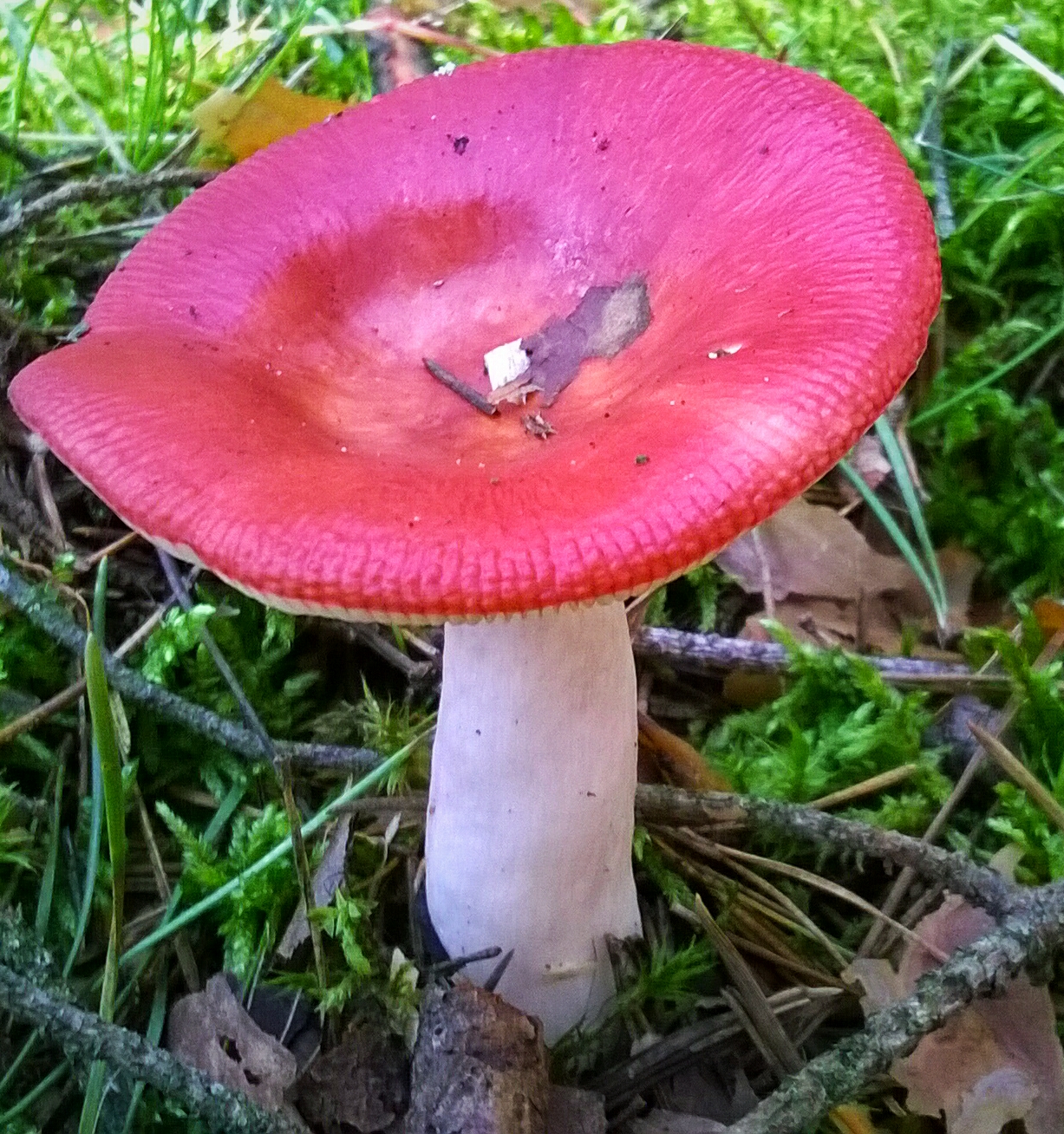
Photo by MichalPL · Wikimedia Commons · CC BY-SA 4.0
The Sickener earns its blunt name honestly. This bright scarlet mushroom with snow-white gills will make you violently ill if eaten raw, delivering a miserable bout of vomiting and diarrhea. It is not going to kill you, but you will wish it had.
Russula emetica is the mushroom kingdom's most straightforward warning label. Its common name, The Sickener, tells you exactly what happens if you eat it. The species name 'emetica' literally means 'causing vomiting.' There is no ambiguity here. This mushroom will wreck your stomach.
The Sickener is a classic Russula: a medium-sized mushroom with a bright cherry-red to scarlet cap, pure white gills, a white stem, and the characteristic brittle flesh that snaps cleanly when you break it (unlike the fibrous flesh of most other gilled mushrooms). It grows in damp coniferous forests across the Northern Hemisphere, particularly in mossy areas under pines and spruces. The cap is often slightly sticky when wet and peels easily from the margin.
The toxin responsible for the gastric assault is thought to be sesquiterpene compounds that irritate the stomach lining. Interestingly, cooking apparently destroys or reduces these compounds, and in some Eastern European traditions, The Sickener was eaten after prolonged boiling with multiple water changes. Modern mycologists universally advise against this. With hundreds of genuinely good edible Russula species available, there is no rational reason to gamble on the one whose name is literally 'The Sickener.'
The Sickener Facts
- ●The classic Russula taste test is one of the most practical identification tools in mycology. A tiny nibble (always spat out, never swallowed) of Russula emetica produces an intensely peppery, burning sensation on the tongue within seconds.
- ●The genus Russula contains over 750 species, many of which are excellent edibles. The general rule of thumb: if a Russula tastes mild, it is likely safe. If it burns your tongue, leave it alone.
- ●Russula flesh is uniquely brittle because of spherical cells called sphaerocysts in the tissue. This gives all Russulas a texture that snaps cleanly like chalk, unlike the stringy, fibrous flesh of most other gilled mushrooms.
- ●Despite its toxicity when raw, The Sickener plays an important ecological role, forming mycorrhizal partnerships with conifers that help trees absorb water and nutrients from poor, acidic soils.
Stories From the Field
The Taste Test That Worked
During a guided foray in the Cairngorms, Scotland, in 2018, a participant picked a bright red Russula and was about to place it in her basket. The foray leader asked her to nibble a tiny piece of cap and spit it out. The burning, peppery taste hit within seconds. She dropped the mushroom immediately, an object lesson in why the Russula taste test exists.
Summer Camp Incident in Vermont
In 2016, two teenage campers at a summer camp near Stowe, Vermont, ate raw red mushrooms on a dare. Both were vomiting within an hour. Camp staff called poison control, and a mycologist identified the species from photos as Russula emetica. Both teens recovered by the next morning.
Russian Grandmother's Boiling Method
In the Novgorod region of Russia, an elderly forager described her lifelong practice of collecting Sickeners, boiling them three times with water changes, and pickling them in vinegar and salt. She claimed she had never been sick. A visiting Finnish mycologist documented the conversation in 2014, noting that while the method may reduce toxins, no scientific study has confirmed its safety.
Where It's Been Found

Based on reported sightings worldwide
How to Identify The Sickener
Cap
4-10 cm across. Convex, becoming flat to slightly depressed in the center. Bright cherry-red to scarlet, occasionally fading to pinkish. Surface smooth, slightly sticky when wet. Skin peels easily from the margin inward, revealing white flesh beneath.
Gills
White, brittle, fairly widely spaced. Attached to the stem or slightly free. Snap cleanly when pressed, a classic Russula feature.
Stem
4-8 cm tall, white, cylindrical, smooth. Brittle and easily snapped. No ring. Solid becoming spongy with age.
Spore Print
White to very pale cream.
Odor
Faintly fruity or like coconut. Sometimes almost odorless.
Mushrooms That Look Like The Sickener
Beechwood Sickener (Russula nobilis)
Very similar red cap and white gills, but grows exclusively with beech trees rather than conifers. Equally emetic. Some mycologists previously classified it as a variety of Russula emetica.
Read more on iNaturalist →Russula silvicola (Woodland Sickener)
Another red-capped emetic Russula found in mixed and coniferous forests. Extremely difficult to distinguish from R. emetica without microscopy. Also causes vomiting. The practical advice is the same: avoid red Russulas with a peppery taste.
Read more on iNaturalist →Russula integra
A brown-red to dark red Russula that is actually edible. Mild taste (not peppery), cream to ochre spore print, and typically grows with spruce. The taste test is key: edible Russulas taste mild, while The Sickener burns like raw chili on the tongue.
Read more on iNaturalist →Is The Sickener Safe to Eat?
Causes acute gastrointestinal distress when eaten raw or undercooked. Symptoms include severe nausea, projectile vomiting, abdominal cramps, and diarrhea, typically beginning 30 minutes to 2 hours after ingestion. Symptoms usually resolve within 24 hours. Not considered life-threatening in healthy adults, but dehydration can be dangerous for children, the elderly, or those with underlying conditions. The raw flesh has a distinctly acrid, peppery taste that should serve as a warning.
Always verify with local experts before consuming wild mushrooms.
Found something that looks like this in the wild? Don't guess — identify it from a photo with Orangutany and check it against look-alikes before you touch it.