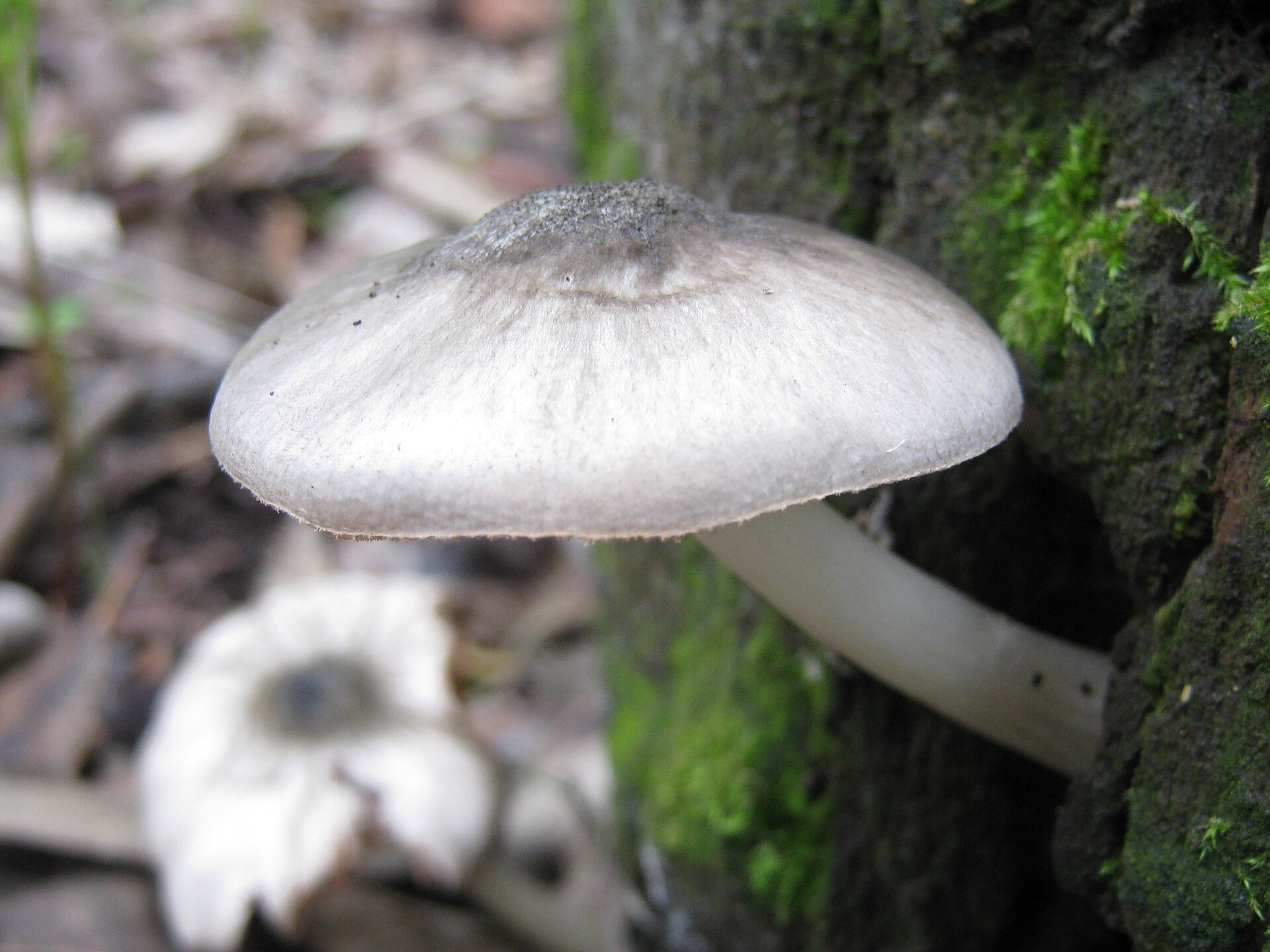
Photo by This image was created by user zaca at Mushroom Observer, a source for mycological images.You can contact this user here · Wikimedia Commons · CC BY-SA 3.0
A small, blue-gray wood-rotting mushroom found across the Northern Hemisphere that was unexpectedly discovered to contain psilocybin. One of only a handful of psilocybin-producing species outside the genus Psilocybe. Contains controlled substances; this page is for educational identification purposes only.
Pluteus salicinus — the Willow Shield — is a quietly fascinating mushroom that hides a psychedelic secret. For most of its taxonomic history, it was known simply as a small, attractive saprotrophic mushroom that decomposed hardwood stumps and logs, particularly those of willow (Salix), alder, and other riparian trees. It was considered unremarkable beyond its pleasant blue-gray cap and free pink gills. Then, in the 1980s, chemical analysis revealed that it contained psilocybin and psilocin — making it one of the very few wood-rotting species known to produce these compounds.
The discovery of psilocybin in Pluteus salicinus was surprising because the compound was thought to be largely restricted to the genus Psilocybe and a few closely related genera. Finding it in Pluteus — a genus with a completely different ecology (saprotrophic on wood rather than growing in soil or dung) and different spore characteristics (pink spore print rather than purple-brown) — raised interesting questions about the evolutionary origins and distribution of psilocybin biosynthesis in fungi. Recent genomic research has shown that the psilocybin gene cluster has been horizontally transferred between distantly related fungal lineages, which may explain its presence in Pluteus.
The Willow Shield is a handsome small mushroom with a distinctive blue-gray to steel-gray cap, sometimes with olive or greenish tones. The cap surface has a satiny sheen and is smooth to slightly wrinkled. The gills are free (not attached to the stem) and start white before turning pink as the salmon-pink spores mature — a characteristic shared with all Pluteus species. The stem is white and smooth, sometimes showing faint blue-green tones at the base.
It's a cosmopolitan species found across Europe, North America, and parts of Asia, wherever suitable decaying hardwood exists along streams and in damp woodlands. It's not rare, but it's easily overlooked due to its small size and preference for half-buried stumps and waterlogged wood.
Willow Shield Facts
- ●One of only a handful of wood-rotting mushrooms known to contain psilocybin — most psilocybin species grow in soil, dung, or grasslands.
- ●The psilocybin gene cluster in Pluteus was likely acquired through horizontal gene transfer from a distantly related fungal lineage — a remarkable example of genes jumping between species.
- ●Despite containing psilocybin, it has a salmon-pink spore print — completely unlike the purple-brown spore prints of Psilocybe species.
- ●The species name "salicinus" means "of willows," reflecting its preference for decaying willow wood along streams and rivers.
Stories From the Field
The Hidden Psychedelic on the Riverbank
For decades, Pluteus salicinus was catalogued as just another small wood-rotting mushroom — pleasant-looking but unremarkable. When chemical analysis in the 1980s revealed it contained psilocybin, mycologists were stunned. The discovery challenged assumptions about which fungi could produce psychoactive compounds and opened up new research into the evolutionary history of psilocybin biosynthesis. Today, genomic studies have revealed that the genes for psilocybin production have been horizontally transferred between fungi multiple times — explaining how this compound ended up in such distantly related lineages.
Where It's Been Found

Based on reported sightings worldwide
How to Identify Willow Shield
Cap
2-7 cm across. Convex to broadly convex, sometimes slightly umbonate. Blue-gray, steel-gray, or gray-green, sometimes with olive tones. Surface smooth to slightly wrinkled, with a satiny or silky sheen. Hygrophanous — paler when dry.
Gills
Free (not attached to stem), crowded. White when young, becoming salmon-pink as spores mature. Broad, ventricose (widest in the middle).
Stem
3-8 cm tall, 4-8 mm thick. White, smooth, sometimes with faint blue-green tones near the base. Solid, fibrous. No ring or volva.
Spore Print
Salmon-pink to pinkish (distinctive Pluteus spore print — very different from the purple-brown of Psilocybe).
Mushrooms That Look Like Willow Shield
Pluteus cervinus (Deer Shield)
The most common Pluteus species. Larger, with a brown (not blue-gray) cap. Also grows on decaying wood with free pink gills. Does NOT contain psilocybin. The brown coloring and larger size distinguish it from P. salicinus.
Read more on Wikipedia →Pluteus cyanopus
Another rare psilocybin-containing Pluteus species with stronger blue-green tones at the stem base. Very similar to P. salicinus and may be difficult to distinguish without microscopy. Also contains psilocybin.
Read more on Wikipedia →Entoloma species
Some Entoloma species have similar blue-gray caps and pink spore prints. However, Entoloma gills are attached to the stem (not free like Pluteus), and many Entoloma species are poisonous. The free gills of Pluteus are the key distinguishing feature.
Read more on Wikipedia →Is Willow Shield Safe to Eat?
Contains psilocybin and psilocin in variable amounts — controlled substances in most jurisdictions. Psilocybin content is generally lower than in Psilocybe species. This species is documented for educational identification purposes only.
Always verify with local experts before consuming wild mushrooms.
Found something that looks like this in the wild? Don't guess — identify it from a photo with Orangutany and check it against look-alikes before you touch it.