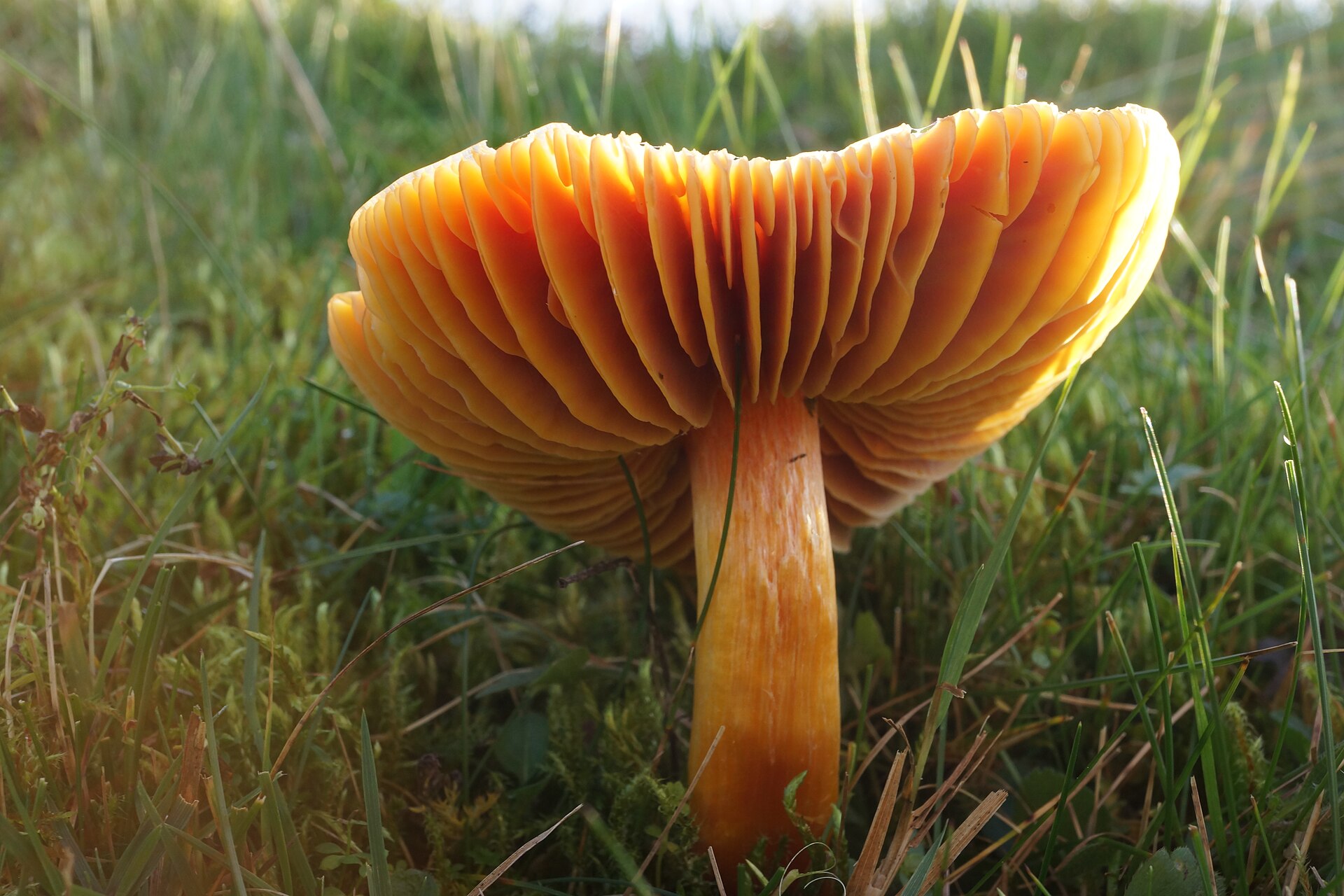
Photo by Dr. Hans-Günter Wagner · Wikimedia Commons · CC BY-SA 2.0
A jewel-bright scarlet mushroom that lights up old grasslands in autumn. The Scarlet Waxcap is one of Europe's most visually stunning fungi and a key indicator species for ancient, unfertilized meadows. Though technically edible, it is far more valuable left in place as a conservation marker.
There is no subtlety to a Scarlet Waxcap. It appears on short-cropped grassland like a drop of arterial blood on green velvet: impossible to miss, impossible to mistake for anything ordinary. The cap is a deep, saturated scarlet red with a waxy, slightly greasy sheen that catches the light. It is, by any measure, one of the most beautiful mushrooms in the Northern Hemisphere.
Waxcaps as a group (Hygrocybe and related genera) are the orchids of the fungal world. They are associated almost exclusively with old, nutrient-poor, unimproved grasslands, the kind of ancient pastures and churchyard lawns that have never been plowed, fertilized, or reseeded. These habitats are vanishing across Europe at an alarming rate, and waxcap diversity has become one of the primary tools conservationists use to assess grassland quality.
The 'waxcap grassland' concept, developed largely by British and Scandinavian mycologists, holds that the number and diversity of waxcap species in a meadow directly reflects its ecological value. A grassland with 10 or more waxcap species is considered internationally important. Hygrocybe coccinea is one of the more common species in these surveys, but its presence still signals a site worth protecting.
While technically edible, Scarlet Waxcaps are small, not particularly flavorful, and far too ecologically important to collect in quantity. The prevailing attitude among foragers and mycologists alike is: photograph them, record them, enjoy them, leave them alone.
Scarlet Waxcap Facts
- ●Waxcap grasslands are sometimes called the 'tropical rainforests of Europe' due to their irreplaceability: once a meadow is plowed or fertilized, waxcap communities vanish and do not return for decades, if ever.
- ●The exact nutritional strategy of waxcaps remains debated. For years they were thought to be saprotrophic, but recent research suggests they may be biotrophic, forming associations with moss and grass roots.
- ●A single churchyard lawn in Wales was found to contain 33 species of waxcap, more than many nature reserves thousands of times its size.
- ●The waxy texture of waxcap gills is caused by unusually long, inflated cells (basidia) that give them a slippery, almost plastic feel unlike any other mushroom group.
Stories From the Field
The Churchyard Waxcap Survey
In the 2000s, Plantlife and the British Mycological Society launched a survey of churchyard fungi across Wales and England. They discovered that many old churchyards, with lawns mowed for centuries but never fertilized, harbored extraordinary waxcap diversity. Some small churchyards contained 15 or more waxcap species, qualifying them as sites of international conservation importance.
The Norwegian Meadow That Changed Conservation Policy
A survey of traditional hay meadows in western Norway found waxcap assemblages so diverse that the Norwegian government added several meadows to its national list of priority habitat types. The presence of Hygrocybe coccinea alongside 20+ other waxcap species was cited as evidence of the meadows' centuries-old management history.
Photographing the Scarlet Jewels
A nature photographer from Devon posted a series of close-up images of Scarlet Waxcaps on a mossy hillside after autumn rain. The water droplets on the waxy red caps caught the low October sunlight, producing images that went viral in mycology groups. 'These are the moments that make you fall in love with fungi,' she wrote.
Where It's Been Found

Based on reported sightings worldwide
How to Identify Scarlet Waxcap
Cap
2-5 cm across. Convex, becoming broadly convex to flat, sometimes with a slight central depression. Vivid scarlet red, fading slightly toward the margin or with age. Surface smooth, waxy, slightly greasy to the touch, especially when wet.
Gills
Broadly attached to slightly decurrent. Moderately spaced. Yellow to orange-yellow with reddish edges, waxy in texture. The waxy feel of the gills is a defining characteristic of all waxcaps.
Stem
3-6 cm tall, 5-10 mm thick. Red to orange-red, often paler (yellowish) toward the base. Smooth, dry, hollow, slightly compressed. No ring, no volva.
Spore Print
White.
Odor
Not distinctive. Mild, slightly mushroomy.
Mushrooms That Look Like Scarlet Waxcap
Crimson Waxcap (Hygrocybe punicea)
Larger (cap up to 12 cm), with a more conical cap shape and a fibrous, streaky stem. Color is similar deep red but often darker. Also found in waxcap grasslands. Edible. Distinguished by its larger size and stem texture.
Read more on First Nature →Vermilion Waxcap (Hygrocybe miniata)
Smaller (cap usually under 3 cm), with a more finely scaly cap surface and a thinner stem. Similar bright red color. Found in similar grassland habitats. Edible but too small to be worthwhile.
Read more on iNaturalist →Is Scarlet Waxcap Edible?
Technically edible but not recommended for collection. Scarlet Waxcaps are small, not particularly flavorful, and are important indicator species for threatened grassland habitats. Many mycological societies and conservation organizations discourage picking waxcaps. In some countries, waxcap grasslands have legal protection, and collecting fungi from them may be prohibited.
Always verify with local experts before consuming wild mushrooms.
Found something that looks like this in the wild? Don't guess — identify it from a photo with Orangutany and check it against look-alikes before you touch it.