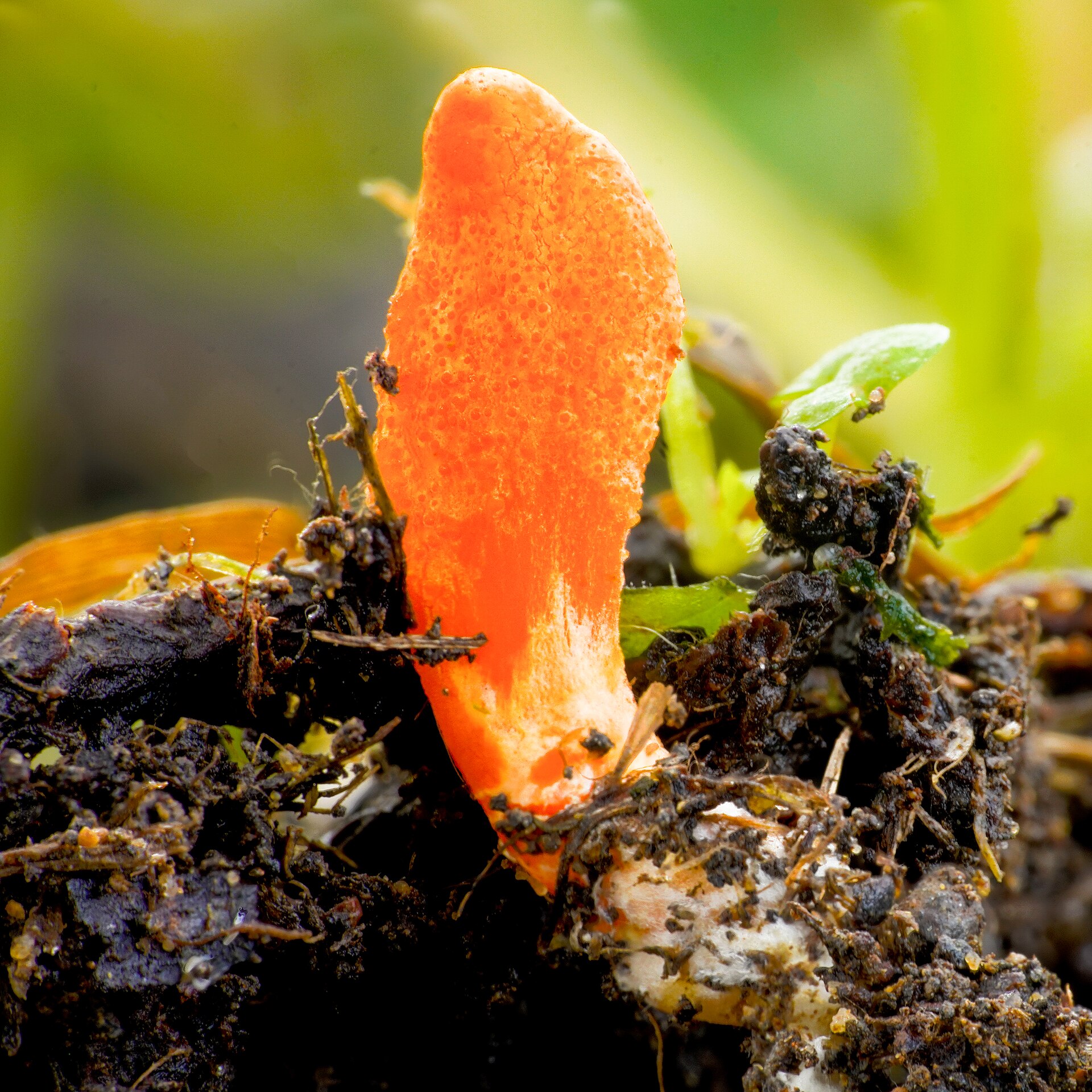
Photo by Matej Frančeškin · Wikimedia Commons · CC BY 4.0
A vivid orange parasitic fungus that infects and kills buried insect pupae, then sprouts a club-shaped fruiting body from the corpse. Cordyceps militaris is the most common and widespread Cordyceps species, found across the Northern Hemisphere, and is now commercially cultivated as a substitute for the astronomically expensive Ophiocordyceps sinensis.
There is something deeply unsettling and deeply fascinating about Cordyceps. The concept is simple and brutal: a fungal spore lands on an insect, germinates, invades the body, consumes it from the inside, and then erupts a fruiting body from the remains to spread more spores. Cordyceps militaris does exactly this, targeting the buried pupae of moths and butterflies in forest soil.
The fruiting body is a slender, club-shaped structure, 2-8 cm tall, colored vivid orange to scarlet. It pokes up through the leaf litter like a tiny, crooked finger. If you carefully excavate the base, you will find the mummified remains of the host insect, now a hardened, fungus-filled husk. The entire organism, from the dead pupa to the orange club, is called a 'stroma.'
Despite the horror-movie lifecycle, Cordyceps militaris has become a darling of the health supplement industry. It contains cordycepin, a nucleoside analog with demonstrated biological activity in lab studies, including anti-inflammatory, anti-tumor, and immunomodulatory effects. Because the much more famous (and much more expensive) Ophiocordyceps sinensis cannot be commercially cultivated, C. militaris has become the primary cultivated alternative. It grows readily on grain-based substrates in laboratory conditions, no insect host required.
Commercial production of Cordyceps militaris has scaled up dramatically in China, South Korea, and Thailand. The cultivated product is sold as a health supplement in capsules, tinctures, and powders. It is also used as a culinary ingredient in traditional Chinese soups and hot pots, where the bright orange clubs add color and a mild, savory flavor.
Scarlet Caterpillar Club Facts
- ●Cordyceps militaris can be commercially cultivated on grain substrates without any insect host. The fungus happily fruits on brown rice in controlled conditions, making industrial production straightforward.
- ●The compound cordycepin, first isolated from Cordyceps militaris, is a nucleoside analog that has been studied for anti-cancer, anti-viral, and anti-inflammatory properties. It interferes with RNA synthesis in cells.
- ●Despite being widespread and reasonably common, Cordyceps militaris is easily overlooked in the wild. The fruiting bodies are small, often hidden in deep leaf litter, and their orange color can blend with autumn leaves.
- ●The video game and TV series 'The Last of Us' features a fictional Cordyceps that infects humans, inspired by real Cordyceps species that control insect behavior. Cordyceps militaris does not control host behavior, but its tropical relative Ophiocordyceps unilateralis does.
Stories From the Field
The Cordyceps That Broke the Internet
The BBC's Planet Earth II documentary featured a segment on Ophiocordyceps unilateralis ('zombie ant fungus') that went massively viral. While that species is tropical, the segment brought global attention to the entire Cordyceps group. Google searches for 'Cordyceps' spiked by over 2,000% in the weeks following the broadcast, and sales of Cordyceps militaris supplements surged.
South Korea's Cordyceps Cultivation Industry
South Korea has become one of the leading producers of cultivated Cordyceps militaris. Korean researchers developed optimized growing protocols using brown rice substrates in climate-controlled chambers, achieving consistent production of high-cordycepin fruiting bodies. The industry was valued at over $100 million by the mid-2010s.
A Mycologist's Lucky Find in the New Forest
A British mycologist described finding a cluster of seven Cordyceps militaris fruiting bodies in a single square meter of mossy beech woodland in the New Forest. Careful excavation revealed each one was connected to a separate moth pupa. She photographed the entire excavation process, producing a set of images that became widely used in UK mycological education materials.
Where It's Been Found

Based on reported sightings worldwide
How to Identify Scarlet Caterpillar Club
Cap
No distinct cap. The fruiting body is a club-shaped to cylindrical stroma, 2-8 cm tall, 3-8 mm wide. Surface is covered in tiny, densely packed bumps (perithecia) that give it a finely granular texture. Color is vivid orange to scarlet-orange, sometimes fading to pale orange with age.
Gills
No gills. Spores are produced inside perithecia (flask-shaped structures) embedded in the surface of the club. The bumpy texture of the surface reflects these embedded structures.
Stem
The lower portion of the stroma is smoother and paler (yellowish-orange to whitish), transitioning to the fertile, bumpy upper portion. The base connects to the mummified insect host in the soil.
Spore Print
Not practically obtainable in the field. Spores are released from the perithecia as long, thread-like ascospores that fragment into individual cells.
Odor
Mild, not distinctive.
Mushrooms That Look Like Scarlet Caterpillar Club
Tolypocladium capitatum
Very similar in appearance but typically associated with moth pupae in North American coniferous forests. Slightly paler orange. Reliable distinction requires microscopic examination of spore morphology.
Read more on iNaturalist →Orange Club Fungi (Clavulinopsis species)
Some small orange club fungi could be confused at a glance. Key difference: Clavulinopsis species grow from soil or leaf litter with no insect attachment at the base. Excavate the base of a suspected Cordyceps, and you should find the mummified host insect.
Read more on iNaturalist →Is Scarlet Caterpillar Club Edible?
Edible and commercially cultivated as a health supplement and culinary ingredient. Wild specimens are too small and rare to be of practical culinary value, but cultivated Cordyceps militaris is widely available. Used in traditional Chinese medicine and cuisine, particularly in soups and tonics. Contains cordycepin, a compound with demonstrated biological activity in laboratory studies. Generally considered safe, though people with autoimmune conditions or on immunosuppressant medications should consult a doctor.
Always verify with local experts before consuming wild mushrooms.
Found something that looks like this in the wild? Don't guess — identify it from a photo with Orangutany and check it against look-alikes before you touch it.